At the peak of Maunakea, among some of the most advanced astronomical tools in the world, the W. M. Keck Observatory operates twin telescopes, each weighing 300 tons and operating ten-meter mirrors. Visible from HPA’s campus on any clear day, they are rarely seen up close by lay-people. Yet on a frigid day last March, Brianna Ryan ’19 made the trek to 14,000 feet, her toes freezing in the sub-zero temperatures and a hard hat on her head as protection from the falling ice that accompanied high winds. This adventure was a culmination of her work as an intern for Keck, an opportunity made possible through HPA. “If it weren’t for HPA,” she says, “I wouldn’t be the budding scientist I am today.”
Born and raised on Kauai, Ryan attended a small town high school that didn’t focus on college preparation. By the end of freshman year, she maxed-out the curriculum, having taken high school classes since seventh grade. A friend encouraged Ryan to look into HPA, and after a tour she was, she explains, “in love”—not only with the possibilities for studying advanced math and physics but also with the HPA Energy Lab.
If it weren’t for HPA, I wouldn’t be the budding scientist I am today.”
As a sophomore, Ryan jumped right into upper-level courses at HPA, including Multivariable Calculus, English 11 Honors, and AP Physics C. She began ISR (Independent Science Research) at the E-Lab, working on her idea for a particle physics website geared toward high school students and joining other student projects, including the Hi-SEAS Mars simulation on Maunaloa (for which the E-Lab monitors data) and an exploration of inter-space settlements.
However, Ryan’s most exciting research opportunity occurred when she was selected as a Keck Observatory intern in the fall of 2018. Now, on top of an already demanding course-load, Ryan spends about 10 hours a week at Keck’s offices in Waimea, with another six hours of her own time focused on independently analyzing data or coding.
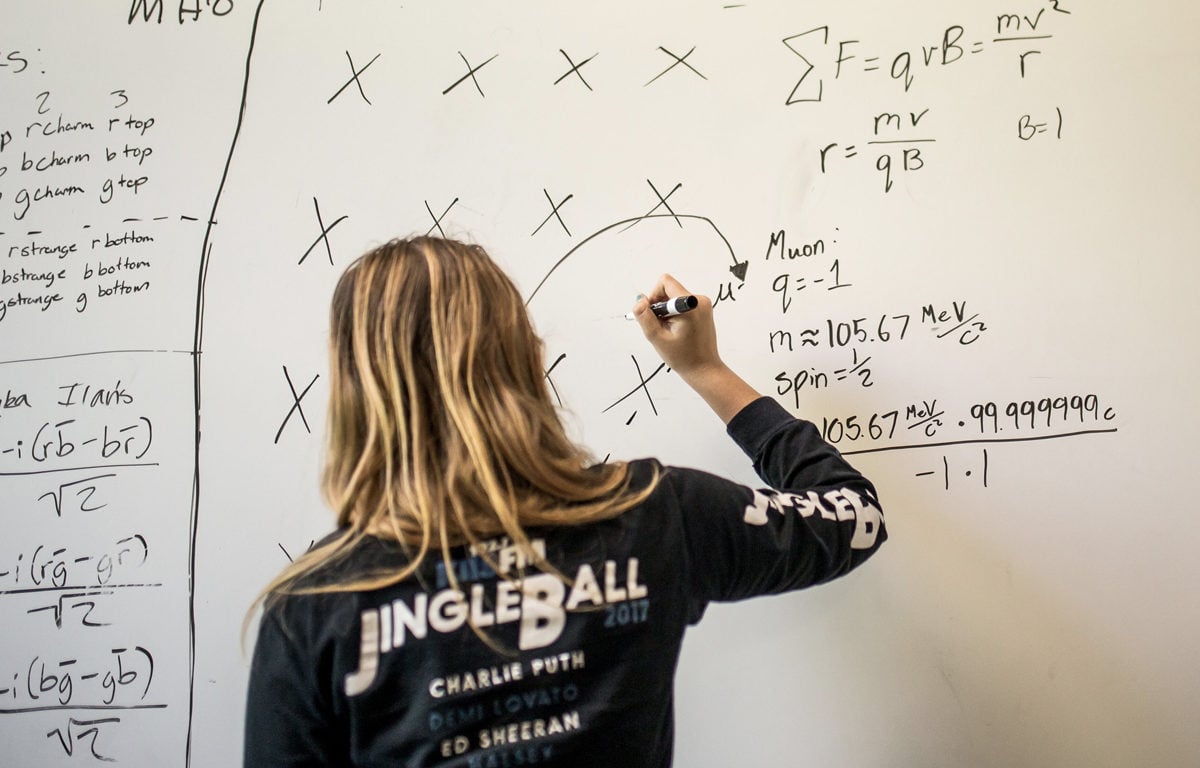
Ryan’s project with Keck involves some impressive, high-level research: developing programs to enable computers to analyze light (spectral data) from embedded stellar clusters, which are often clouds of gas full of active star formation. In layman’s terms, she is looking at the birth of stars. Brianna works with Python, a common coding language for STEM, creating a platform for data reduction for MOSFIRE, an infrared detector. Her most challenging bit of coding involved creating a method for reading spectral data for a particular type of star—longslit, A0 stars—and using it to subtract Earth’s atmosphere from the rest of the data. This research will move forward our understanding of how stars are formed.
Her experience with Keck won’t necessarily end once she leaves HPA. This fall, Ryan is off to MIT, but she will remain part of her project’s final stages. “It would be nice,” she says modestly, to not only have her name on the final published paper when this work goes public but more importantly see her work come to fruition. In future, she has her own questions and theories about embedded clusters that she’d like to answer. “It’s incredibly exciting,” she says, “to be part of creating new knowledge, generating information that other people, even future high school students, will one day use and study.”