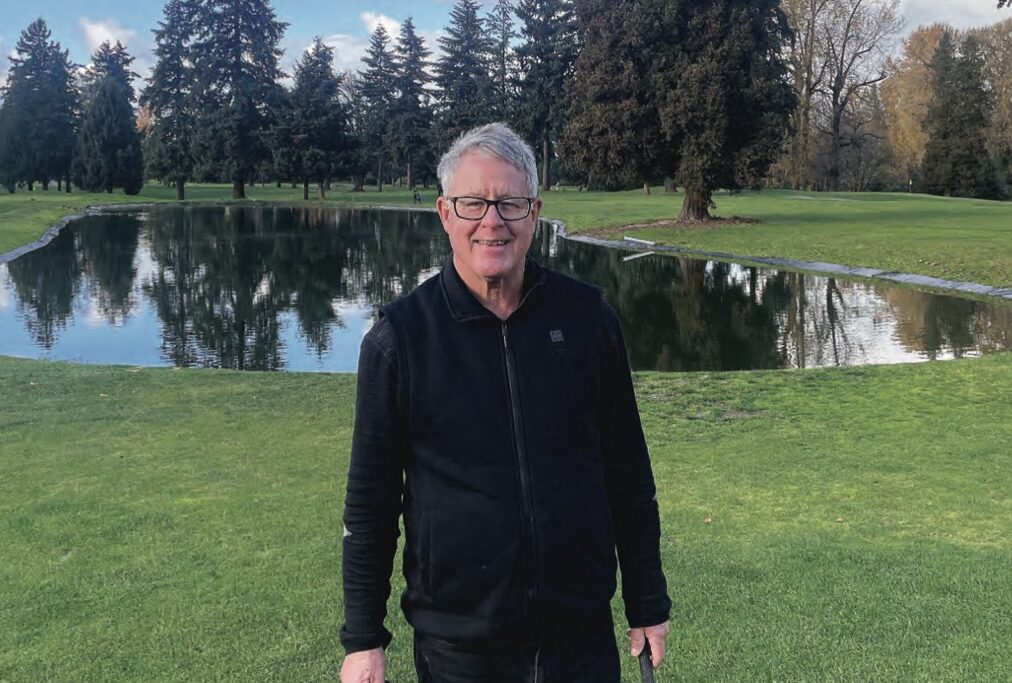
Ed (Camp) Campbell ’71 has a story to tell and a connection to make for just about everything, from cars and cargo to soccer and surfing. More than just another successful businessman and CEO, Campbell has carved his own path, winning friends and influencing people along the way. “No matter where I go, I’m talking to someone who asks me if I know Ed Campbell,” says Nathan Burkland ’05, Campbell’s colleague and fellow Ka Makani. “He’s everywhere in our corner of the world.”
That corner is the Pacific Northwest, Idaho, Alaska, and Seattle specifically. Campbell’s business, Commercial Chemtech, Inc., is an industrial water treatment service, helping businesses, schools, data centers, and hospitals manage the flow of water within their buildings or ships. Burkland, son of Al Burkland ’71, joined Campbell’s business years ago. Though he was neither a chemist nor an engineer by training, Burkland has become an indispensable part of the company’s success. “Nathan is always in the eye of the storm,” Campbell says. “He’s a key part of our team.”
Industrial water treatment is “the infrastructure no one sees,” Campbell says. “Our chemistry products can change the energy efficiency of a building by 60%, while using less water.”
In industrial processes, water’s solvency makes it valuable for cleaning, cooling, and chemical reactions. It also means that water easily picks up impurities, which is why proper water treatment is essential. “One of our basic chemicals that we put into the buildings is a proprietary chemical formula that we came up with,” says Campbell. “It uses lignin pitch, or tree resin, to create a monomolecular film that when put into the hydronic loops of buildings prevents the pipes from corroding. Clients love it!”
Commercial Chemtech certifies steam in hospitals, maintains the massive boilers at Seattle-Tacoma International Airport, treats the industrial water system for the Seattle Aquarium … and the list of clients goes on and on.
Campbell attributes at least some of his success to what others might take as a setback. “One of the great things about being ADD is that you’re perfect for being a CEO,” he says. “You talk to a client, then you hang up and talk to insurance, then a lawyer, then factory people. Everything is bouncing off the walls at times … I spray out the ideas, and I rely mostly on my kids around me to organize them. John Bingham ’71, my HPA roommate, really helped me focus and read some crazy papers I wrote.”
Please read this in five minutes so I can preserve some of my 15 minutes of fame for winning the lottery.
Campbell grew up surfing the waves of Black Point with Dick Bates ’71 on O‘ahu. His father’s side of the family brought the first Ford cars to Hawai’i with the Murphy ‘ohana, and Campbell worked for his dad changing tires with Congressman Ed Case ’70. Before boarding at HPA, he attended Kaimukī Intermediate School (now Kaimukī Middle School), and surfed with William Finnegan, author of the Pulitzer Prize-winning biography Barbarian Days, a Surfing Life.
At HPA, Judy Hancock taught him how to paint, and Will Hancock taught him business and economics. (“I was able to pay for my kids’ college thanks to what I learned from Will.”) Charlie Van Riper taught him the scientific method. (“We’d take blood samples from the birds and analyze the way avian malaria spread.”) The German chefs who came to work in Rockefeller’s Mauna Kea hotel taught him scissor kicks and other soccer skills. (“On Sundays they came up and played our soccer team.”)
Campbell clearly cherishes all he’s learned and the relationships he forged at HPA. In many ways, he embodies the values of HPA, particularly ‘ohana and the idea that education should lead to a meaningful and satisfying life, creating a lasting sense of wonder.
Today, Campbell is trying to work a little less in favor of spending more time with his family. He and his wife have two daughters, a son, and six grandchildren who play soccer in their backyard. They all live nearby in West Seattle and share family dinners regularly.
“In some ways,” Campbell reflects, “I really tried to model my company as a family operation, inspired by Kelly Beal ’72. He has a big, successful family business, and that’s really why my kids are in my company.”
When asked if he has advice for HPA students today, he hesitates, and ultimately offers a brief, poetic response. “See more and be more in each encounter.” And then he recalls the advice of another classmate’s father: “Tony Rutgers’ dad gave the commencement address to our class, and I found his advice valuable in my life. It was to keep your sense of humor and don’t let your prejudgments become prejudice.”
This story originally appeared in the 2025 spring/summer edition of Ma Ke Kula. Read the full issue here.