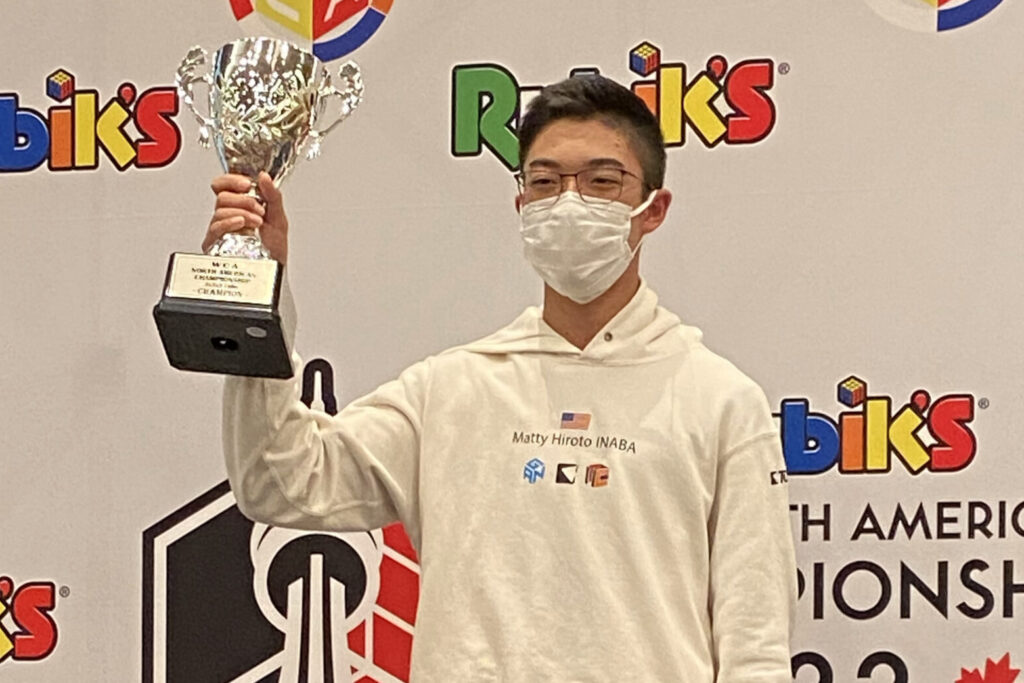
Blink, and there’s a good chance you’ll miss it. That’s how fast 16-year-old Matty Inaba ‘25 can solve a Rubik’s Cube.
He maneuvers the plastic puzzle with such lightning speed that if you don’t witness him demonstrate it in real life, it would be easy to believe his videos were edited in fast-forward mode.
The reigning Northeastern and North American champion, Matty is also ranked third in the world for his average of five scores on a 3×3 — which, by the way, is his favorite size cube to compete with even if it’s not the hardest to solve because he says it’s the most challenging to get faster at.
“It’s just a matter of time and going to more competitions,” the HPA sophomore says with a grin.
His confidence is infectious, just like his joy for cubing. (Apparently, that’s what the cool kids are calling it these days, and Matty — who carries no air of boastfulness, just pure excitement for problem-solving — is definitely a cool kid.)
Matty saw his first Rubik’s Cube at a department store in Japan while traveling with his mom — HPA Upper School Nihongo teacher, Rika Inaba. She was hesitant at first to purchase it for him, afraid that he would be frustrated by it, but 9-year-old Matty was able to convince her.
“I was immediately hooked,” Matty said.
It took him the whole day to solve his first cube. Now, he can solve one at home in 3.01 seconds. That’s the average time it takes a person to sneeze. Even the fastest cars in the world need at least three seconds to get from 0 to 60 mph.
Matty’s fastest time in competition is 4.27 seconds. To put that speed into perspective, the world record this summer was a 5.08-second average [of five scores].
Here’s what you need to know about cubing: in competitions, judges take your average of five scores. They drop your best time and your worst time and determine the player’s average with the remaining three scores.
During the Northeastern Championship in Boston this past summer, Matty got a 4.48 on his best solve. But when Matty hit the buzzer to record his time, the top of the cube shifted just enough to trigger a two-point penalty for not being completely flush. Just like that, his best solve ever turned into a 6.48 score.
Without the penalty, Matty would have beaten the world record and finished the competition with an average of under five seconds for the first time ever. To be clear, Matty still won the competition.
The penalty only fuels his passion and pursuit.
“The goal is No.1 world ranking and the world championship title,” Matty said. “I can get it. I just gotta get lucky.”
They say luck is when preparation meets opportunity — and Matty is surely putting in the work. He practices about 30 minutes daily, which at his speed represents roughly 100 solves.
When asked what the end goal is, Matty chuckles at the suggestion that cubing will make him rich and famous one day. Instead, he says he just started doing it as a way to learn how to compete and get good at things.
“I just want to see how far I can get when I set my mind to something,” Matty explained.
His regional, national, and global rankings are clear indicators he has already achieved great success, but it’s the local impact he’s had that Matty is most proud of.
In 2016, Matty was the only competitor from Hawaiʻi at a national level. It took another two years before the first competition was held in Hawaiʻi. But on the last weekend of September, Matty attended an event on Oʻahu where 40 new competitors participated.
I just want to see how far I can get when I set my mind to something”
“How cool is that?” he said smiling wide. “And the majority of them are from Hawaiʻi.”
U.S. Nationals are in Pittsburgh, Pennsylvania next summer. From there, on to Seoul, Korea, where Matty hopes to bring home the World Championship trophy.
When asked what he plans to tackle next after cubing, Matty pauses, before thoughtfully answering, “We’ll see. I’m gonna achieve my goals with this first, and then I’ll decide.”
Either way, it’s a problem, we’re confident he’ll be able to solve.