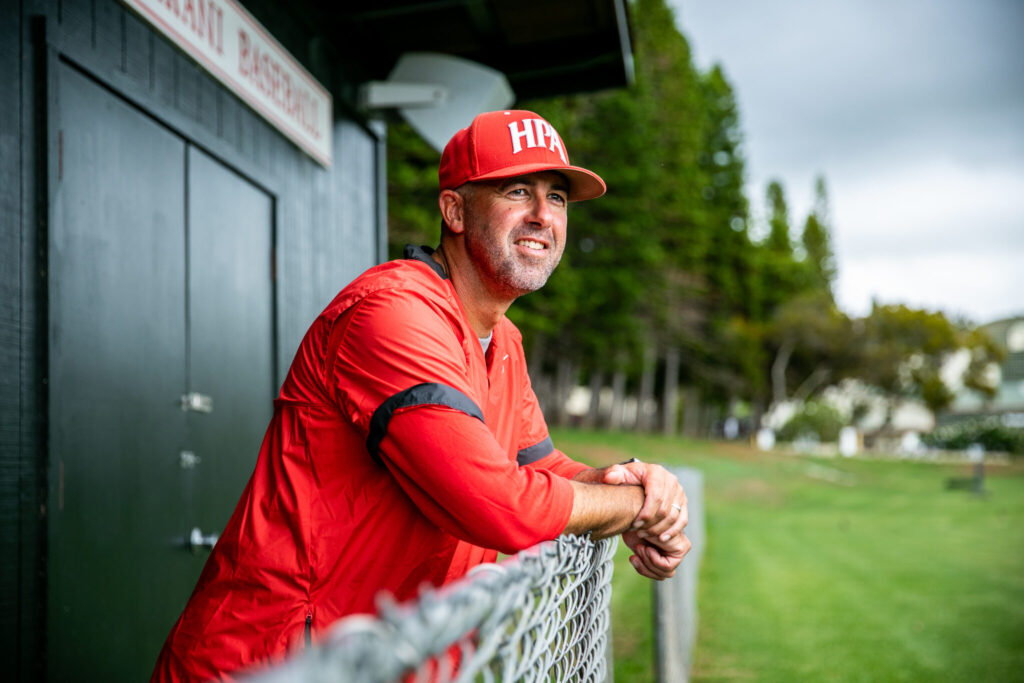
Talk a bit about your background, your journey here as a coach and teacher, and your hopes for the future. How did you fall in love with baseball?
I was born in Illinois, but I spent most of my life in Colorado, went to elementary school in Colorado, and played baseball in high school at Standley Lake High School in Westminster. Then I went on and then I played in college at Western State College in Gunnison, Colorado. My high school was in the mountains at 7,000 feet. So it’s not wasn’t super conducive to baseball and it was cold all the time. When I played, we spent the first half of our season on the road and played our away games. Then we’d get to play the second half at home when the snow finally melted.
I knew that baseball would be done for me after I played in college. I majored in mathematics, and I decided I wanted to be a teacher. I ended up at another school near my old school called Pomona. I did my student teaching there. Right then and there, I fell in love with coaching. We had a really great program there, and I spent eight years there teaching and coaching. I was an assistant coach there for most of the time.
From there, I moved to Mountain Range High in Westminster, Colorado. I was hired as a head coach there, where I could experience starting a program from scratch. We had a brand new program there; we ordered the uniforms, the nets, the baseballs, and the bases. I also spent eight years there and really enjoyed my time there. I made some of my closest professional friends there.
After that, Faith Christian High hired me as their athletic director and I went back to being an assistant coach. I spent five years there, and we won a state championship in 2016. I truly loved that job. Then, after a while, I just felt like we wanted to do something different as a family. That is what led us out to Hawaii. Here we are now.
Can you talk about one of those seasons in your time as a baseball coach?
I was lucky when I was at Pomona. That was my fourth year coaching. It is interesting because in my second year at Pomona, we lost in the state championship game. At the time, I was thinking, we’ll probably never make it back. That was in 2002-03. We won the state championship at Pomona the next year. I remember all those seasons’ moments vividly.
My time at Faith Christian in 2016 was just such a great experience. You know, I had been there that was just my second year there. I just felt like it was super rewarding because we had a really great team. I think I was able to dive in to help others. My job was to give players pointers to put them over the top to get to that next spot in their own careers.
I remember that championship game vividly.
In that game, we gave up a run in the first inning. We had an outfield error, and everybody was tight and nervous, so it was a little frantic at first. Then, our pitcher didn’t give up a hit the rest of the way. We went on to win 6-1.
You have been a coach here for about four years. Can you describe a season that has stood out to you during that time?
My first season was in 2020 during COVID. We played four games and we were 1-3 when COVID hit. I felt good about it. School was not normal of course. But in the 2021-2022 season, when there were nine players, that was the season that stuck out to me. We had 11 players at first, but one broke his jaw and the other was never at practice. So it was definitely hard. We played all of our games with nine and we didn’t win a game that year.
Everybody was positive and just grinding through. We never had to cancel a game, which is pretty cool. That was a testament to the guys that we built up last year. We were able to win five games, and then this year, we’re up to 19 players, and now it feels more like a baseball program.
Can you tell us a little bit about what motivates you to coach?
That goes back to my first year of coaching. A program I was at previously had a really nice field but the coaches mostly did it. I remember our head coach said no matter what, we’re always going to have a nice field and it’s going to start with the coaches putting in the work. Our players are doing the same thing. HPA ballplayers do now here.
You don’t just get to show up and might have a nice space. But if you’re gonna play high school baseball, you deserve to have a nice field. I enjoy seeing our players take great pride in their work.
What’s your favorite part about being a coach for a baseball team?
I love seeing players come together as a team and absorb all the things they’ve learned, like baseball technique, the mental side, and the life lessons you get just by playing any sport. I get the most joy out of seeing a group of guys come together and put all those things into practice. Then everybody, no matter how your season goes as a team, experiences some level of success.
That is what I enjoy the most and then going back and seeing guys graduate and go on to see what they use all those lessons to accomplish later on. That’s the best part of it.
How did you become a coach for HPA?
When I came to HPA, I was fortunate to get a job teaching math and being in the residential program. That’s what ultimately led us to move here with my family. I was going to be an assistant coach. One time, I asked if I could run our winter preseason, and the head coach said, “Go for it.”
Ultimately, we were getting close to the season. It was early January and athletic director Steve Perry caught me in the dining hall. He said, “Coach, we got to talk.” I was like, “What’s going on?” I thought I did something wrong. He told me the head coach had resigned. He was in a bit of a bind and I was coming off being an assistant for the last five years. I was fired up and ready to go. Afterward, I went home and talked about it with my family, and we just said, let’s get back into it.
What should someone expect before they join a baseball program here like yours? What should a player’s mindset be before they walk onto the field?
I think that no matter who you are, you have to be you have to be willing to to be coachable. We have our five traits for success. Regardless of who you are or your skill level, you must be committed to being on time. You need to be committed to having a consistent positive attitude and great effort every day. You want to work towards choosing words that are going to be uplifting but also to push your teammates. It’s okay to push your teammates while being uplifting. We call it taming the tongue. Also, being willing to learn and want to come out and learn something new every day. But if you want to grow as a person and you want to grow as a baseball player, whatever it may be, then we have the right program for you.
What do you hope players take away from being a part of your team?
Hard work. And the ability to handle failure, quite honestly. Every sport has an element of failure. Baseball is not different. If you are successful three out of 10 times in baseball, that success. In professional baseball, that makes you a Hall of Famer. Being successful just 30% of the time results in some failure.
I think that if you take anything away from what we’re doing as a baseball program, it comes from some grit and some tenacity. Some have the ability to fail, and while it is frustrating, being able to bounce back and be able not to give up will fuel you to make you even stronger. Because those successes do always come. It’s finding those positives, learning from the negatives, and letting the negatives be the fuel for your fire. You know, life is not going to be easy.
Who is a coach that you have looked up to?
I’m incredibly fortunate to have started my coaching journey with EJ Maps, the first coach I worked under at my initial school. While he’s not yet a Hall of Famer, there’s no doubt in my mind that he’ll earn that title eventually. Alongside him, I learned from other assistant coaches like Jim Biddle and Dave Roberts, whose son Dave played as our shortstop in our state championship-winning team in ’03.
Later on, as a head coach, I was lucky to have four supportive colleagues. We learned from each other and attended numerous clinics and conventions, soaking up knowledge from experienced coaches like Pat Murphy, who was coaching at Arizona State at the time and is now the Milwaukee Brewers manager.
Throughout my coaching journey, I’ve been privileged to network and learn from various coaches, not only in baseball but also in basketball. One coach who stands out is Mike Dunlap, a former NBA and college coach. His willingness to share knowledge, even through platforms like Twitter, has been invaluable to my growth as a coach.
In the world of college sports, especially baseball, the culture of sharing and learning is prevalent. It’s incredible how accessible and willing coaches are to open their practices to fellow coaches eager to learn. This continuous exchange of ideas and experiences is what makes coaching so fulfilling for me.
What’s your favorite baseball team and player outside of high school baseball?
Well, my favorite team is the Cubs. I don’t know if I even really have a favorite player on the Cubs right.
But I will say one of my favorites is DJ LeMahieu on the Yankees. I don’t love the Yankees. But I love DJ LeMahieu just because he is 6-foot-4 and was at second base. Now he kind of plays all over and could easily drop 40 homers a year if he wanted to. But he’s an all-field hitter and that’s what’s kept him in the game for a long time.
And what are your favorite baseball quotes?
“Average players want constant recognition and positivity while great players want to learn how to get better every single day.”