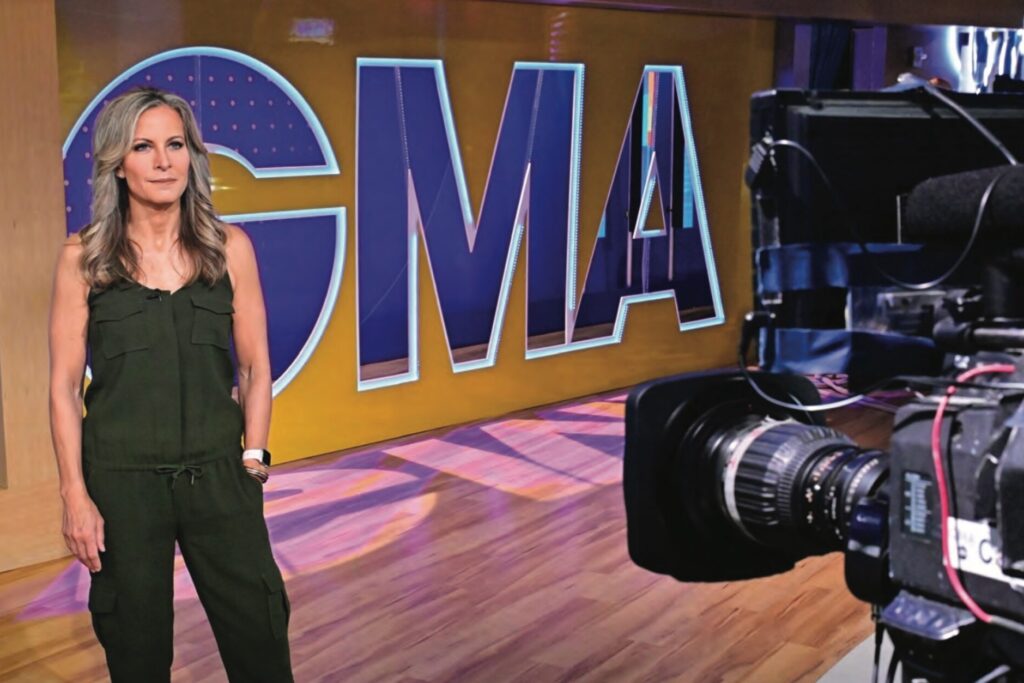
Facing the prospect of her eighteen year-old twins heading off to college this fall, Becky Worley ’88 expresses the typical empty nest feelings, but she also sees what some might consider an unusual upside: “I’ll have time to fish now. That’s amazing!”
For Worley, who has worked at Good Morning America since 2005 and is currently the technology and consumer correspondent for the show, this reaction makes sense. Fishing, in fact, is what first brought her to HPA from Seabury Hall on Maui, which she attended from seventh to 10th grade. “In the summer after 10th, I went on a fishing trip to Christmas Island with a group of families,” she recalls. “Three of the families had kids at HPA. I got home from that trip and said to my parents, ‘I want to switch schools.’”
Worley started at HPA as a junior. “It was full immersion,” she says now. “I played volleyball that fall, and my teammates, the kids in my dorm, and my roommates were all so nice.” Decades later, she notes, “My Ka Makani Wahine crew is a pillar of this phase of my life. The girls I played sports with, borrowed clothes from in the dorms, and cruised Kona from McDonald’s to Old A’s are now the women who I swap parenting advice with, who keep me up to date on our community, and who I raise a little hell with during our somewhat erratic girls trips.”
HPA and the roots of her reporting
Sports proved fundamental to Worley’s time at HPA. In addition to volleyball, she played soccer, basketball, and ran track at HPA, which she connects directly to her success as a reporter and producer. “There are things you learn as an athlete like composure and how to sit in an uncomfortable place and do your best,” she explains. “HPA’s coaches were so supportive and constructively critical, and it’s where I learned a lot of those skills.”
HPA’s focus on project-based learning also provided incredible training for a future reporter. “That philosophy was so important for me to understand who I was as a learner and a worker,” she says. “We had marine biology labs when we went scuba diving. In Hawaiian history classes, we etched the petroglyphs at Puako. Turtle tagging at Kīholo was incredible because we were collecting real information and sharing it with NOAA. The realization that ‘doing’ teaches you more than talking or reading a book was really empowering. That’s 100 percent what TV reporting is — especially the type of consumer reporting I do, where I actually try a lot of things on screen.”
Worley’s experiences beyond the HPA classroom reinforced similar lessons. Her former math teacher Jim Rizzuto, a regular columnist for the Hawai’i Fishing News and a legend in the fishing community and Kona, “would take students on monthly trips for big fish like marlin, tuna, and mahi mahi,” she recalls, “teaching us the whole thing, including about the squid lures and how to clean the fish.”
Even Worley’s less happy fish experiences left her with enduring knowledge. She recalls with laughter her marine biology classmates’ disastrous attempts to recreate a fish skeleton. They tried boiling a fish in chemistry lab; they tried burying a second, hoping ants would eat the meat. In the end, they wrote about their failures and how the assignment was much harder than expected. She and her classmates barely passed, but along the way, it taught them, as Worley explains, “anything that happens informs your sense of the thing, even if it seems and feels like a failure. Project-based learning makes you more comfortable taking chances.”
“There are things you learn as an athlete like composure and how to sit in an uncomfortable place and do your best… HPA’s coaches were so supportive
and constructively critical, and it’s where I learned a lot of those skills.”
A big chance pays off
When senior year arrived, Worley’s college counselor thought she’d be a better fit for the small, rural New England colleges than some of the more obvious big west coast choices. “He explained to me that they were more outdoorsy and active, and he thought I’d like the value structure of these schools more,” she says. “That’s advice I don’t think I would have received anyplace else. It gave me the confidence to give it a shot and apply.” Boarding at HPA added to her sense that she could handle the distance. She ended up at Middlebury, where she played soccer and rugby, majored in American literature, and thrived. (Yes, she also fished.)
The New England climate, however, was not for her. “That weather was … oh, baby,” the long-time Oakland, CA resident says now. She wasn’t ready to return to Hawai’i but was still very interested in fishing and how to make a career of it.
“Thanks to Pat Fisher ’86, Kevin Nakamaru ’86, Harry Kojima, and Jim Rizzuto, I was pretty sure I was destined to have my own fishing show on TV,” she says. “I knew how to fish, so I decided I needed to learn how to make TV.” She headed to Seattle where a connection through Middlebury’s alumni office led to a volunteer position at a local ABC affiliate news station. There, her willingness to take a chance set the first step of her career in motion.
After noticing a college classmate on a live video stream of a Seattle political conference, Worley realized he was Bill Clinton’s personal valet. She managed to get his cell number through the White House switchboard (these were different times) and told him she’d bring her news crew to wherever Clinton was if he could get her an interview. No promises were made, but a location was divulged. “I met with Clinton on the tarmac at Boeing Field,” she says. “I begged him for an interview. He said no. I was crushed. I went back to the news director and said, ‘I’m so sorry, I tried’. And he said, ‘You’re hired.’”
Before long she was managing the station’s technology accounts. The internet was on the rise, which led to a stint at a nascent tech channel in San Francisco owned by Microsoft co- founder Paul Allen, first as a producer and then as the host of a call-in computer help show. The station had a tuition program, so Worley went back to school at Stanford, where she got a master’s in learning, design, and technology through a joint program in the computer science and education departments. As for that fishing show, she did a pilot along the way and quickly abandoned the idea. “It was the most stressful television I’ve ever done. It’s very difficult to produce the fish and make them actually get caught.” When Tech TV went under – “because, shocker, people didn’t want to watch 24 hours about tech support” – she followed a producer from the show to Good Morning America as a regular guest, becoming a contributor in 2005. She took her tech experience on air. “I came in as the gadget girl at GMA,” she recalls. “It was really the time when personal technology was exploding. Personal computers, DVRs, Blackberries, the first Bluetooth headphones and iPhone,” she recalls.
“The kind of TV that I do is really teaching people. That’s why my degree is in education and computer science. At first, it was how to use these devices; later it became the difficulties around things like social media and kids and screens and all of those issues that have evolved over time.”
Branching out beyond tech
After a decade or so, Worley’s reporting field expanded again. “Technology and consumer reporting became very enmeshed because everything had a piece of technology in it,” she explains. “Over time, health came into that. I have a series called ‘The Science of You,’ which is about what’s new in the health space from longevity trends to GLP- 1 drugs.” From there, she broadened out further to be a general consumer reporter covering what she calls “a little bit of everything.” Recently she’s been in Nevada and Oregon for a series profiling all fifty states.
Her wide range also meant she was the ideal person to cover the 2023 wildfires in Lahaina. “Because Maui is my hometown, it was a no-brainer that you’d want someone who knows the terrain, the area, and the impact to go report on that,” she says. Once on the ground, she drew on her HPA contacts and community to help her get the story right. “When I landed in Kahului and Lahaina was blocked off, I saw the smoke rising in Kula and headed upcountry,” she remembers. “Todd Perkins ’85 was my photographer and Morag Rice ’86 was one of the people I interviewed about the community efforts to fight the fires.” Whether she’s covering “local” news like this, the latest in tech or health, or some other aspect of life, Worley has deep appreciation for the variety in her job. “Morning television is the nuttiest television,” she says. “It has such a range. There are times when I’m reporting on really hard subjects and then a few days later, I’m on something where the stakes are low. It has every single type of story you could imagine in it.”
In the end, the variety is a big piece that keeps her going. “I’m always trying to be useful to the viewer,” she says. “How can I share information cohesively? How can I save them time or money, give them something useful, bring some light to their day?” She still credits HPA with that wide-ranging curiosity. “Teachers like Gordon Bryson, the Links, Jay Wilder, and Anne Oldford; the coaches like Greg Mooers, John Colson, Steve Perry, Keali’i Freitas; and extraordinary individuals like Stan Shutes and Auntie June — and so many others I haven’t named — they just poured their investment into us. I am so grateful.”
This article originally appeared in the Summer 2026 edition of Ma Ke Kula. To read more, click here!