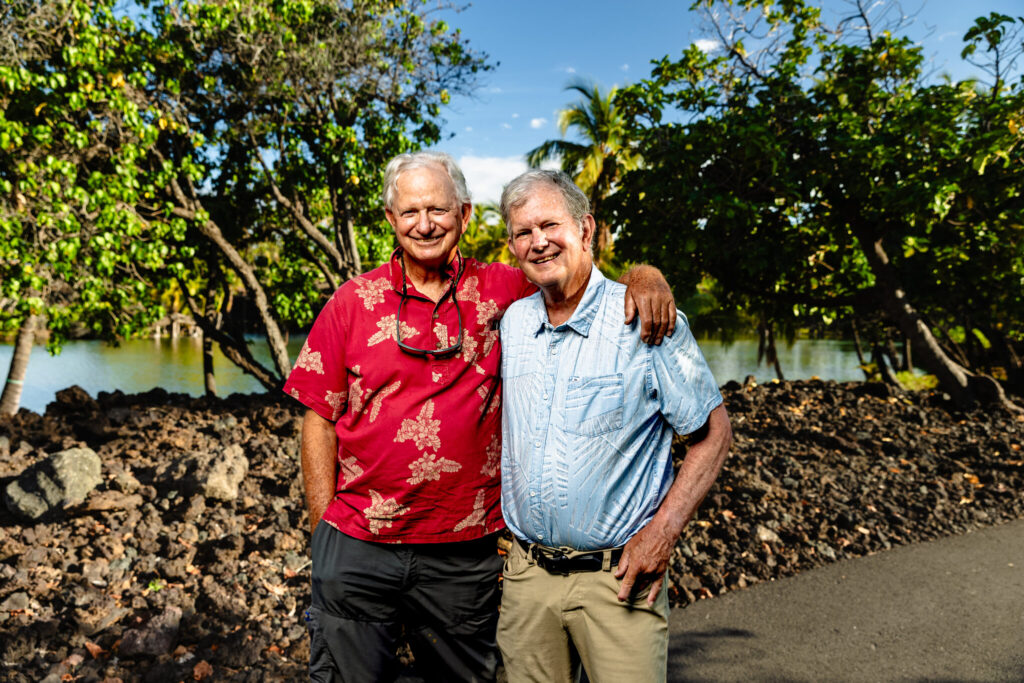
Since their time together at HPA, brothers Peter and Randy Vitousek (classes of 1967 and 1968, respectively) have each become acclaimed professionals in their different fields. Yet their paths still converge in a shared dedication to the land, culture, and future of Hawai’i.
“When I was at HPA,” Peter recalls, “I used to walk down to breakfast from Upper Dorm (now Perry-Fiske) and see Maunakea, Mauna Loa, and Hualālai before me, and I would dream of going there.” Today, Peter’s field work brings him back to Hawai‘i and to those storied places quite often. “Hawai‘i is simply the best place in the world to learn,” he muses. This is no small statement from a man who has spent much of his life in academia.
After graduating from HPA, Peter completed his undergraduate studies at Amherst College in 1971 and earned a Ph.D. in biology from Dartmouth College in 1975. Since then, he has taught at Indiana University, the University of North Carolina at Chapel Hill, and Stanford University, where he remains a professor in the Department of Earth System Science. Over the years, his work has made Peter a renowned ecologist, recognized especially for his research on the nitrogen cycle. In Hawai‘i, his work centers on understanding intensive rain-fed agricultural systems. He was elected to the National Academy of Sciences in 1992 and became a Fellow of the American Academy of Arts and Sciences in 1993. Accolades aside, the work Peter is most proud of is his work within the Hawaiian community, much of which is rooted in understanding the symbiosis between culture and ecology. “There is a view in social sciences of culture being independent from land, but I don’t think it’s independent. I think if you talk to most indigenous people, the land is really important in the development of culture.”
Though Randy maintains that his brother was always “the more academic one,” Randy went on to Williams College in Massachusetts after HPA, and was part of the first graduating class from the University of Hawai‘i Richardson School of Law. For decades, Randy has served as the Resident Partner at Cades Schutte, LLP’s Hawai‘i Island office, where he represents clients in matters related to land use, permitting, environmental concerns, and long-term planning – always with an eye towards deepening their understanding of place, culture, and community. “To me,” he says, “the important part is that my work life has enabled me to live in Kamuela, to be close to our children, be close to our friends, and be close to the environment… and really try to give back to our community on a daily basis, because it’s so special and has given so many gifts to our family.”
“That’s for sure,” Peter agrees.
In the spirit of “giving back,” both Peter and Randy have dedicated many years of service on the HPA board of trustees. Both are passionate about forging pathways for HPA students and graduates to share the wisdom of Hawai‘i with a world in need of its influence. The brothers are eager to see the school and its students continue to dig deep roots: “We are at the confluence of a rigorous academic education and the cultural history of people who have this intimate relationship with and knowledge of their land,” Randy says. “People should connect themselves to Hawai‘i, and through Hawai‘i to the world as much as they can,” Peter adds. “I think the world needs what HPA and Hawai‘i have to offer. We can be a big part of that. Bringing Hawai‘i to the world.”
I think the world needs what HPA and Hawai‘i have to offer.”
HPA has indeed made strides to ensure that its students are grounded in culture and traditions across all aspects of our curriculum. From science, technology, and the arts, to food systems, outdoor programs, and community service, an integrated vision of Hawaiian studies has flourished under the care of Kumu Kūwalu Anakalea at the Village Campus, and Kumu Pualani Lincoln Maielua ’01 at the Upper Campus. This includes an expansion of the network of kupaʻāina (lineal descendants of the land) that support HPA’s indigenous and place-based learning. Ultimately, these efforts are an integral link connecting HPA students to the wider community and the world – creating pathways between the past and the future.
Reflecting on his own three children’s experiences at HPA, Randy notes the strong bonds and community commitment that have emerged among their generation. “They are now in the situation where they are making their marks,” Randy says. “They’re saying, ‘This is our turn, we’re going to take care of our island and our community.’ And they are. It’s very, very heartening. They’re doing it well and together and with the right attitude. A lot of that came from our collective experience at HPA.”