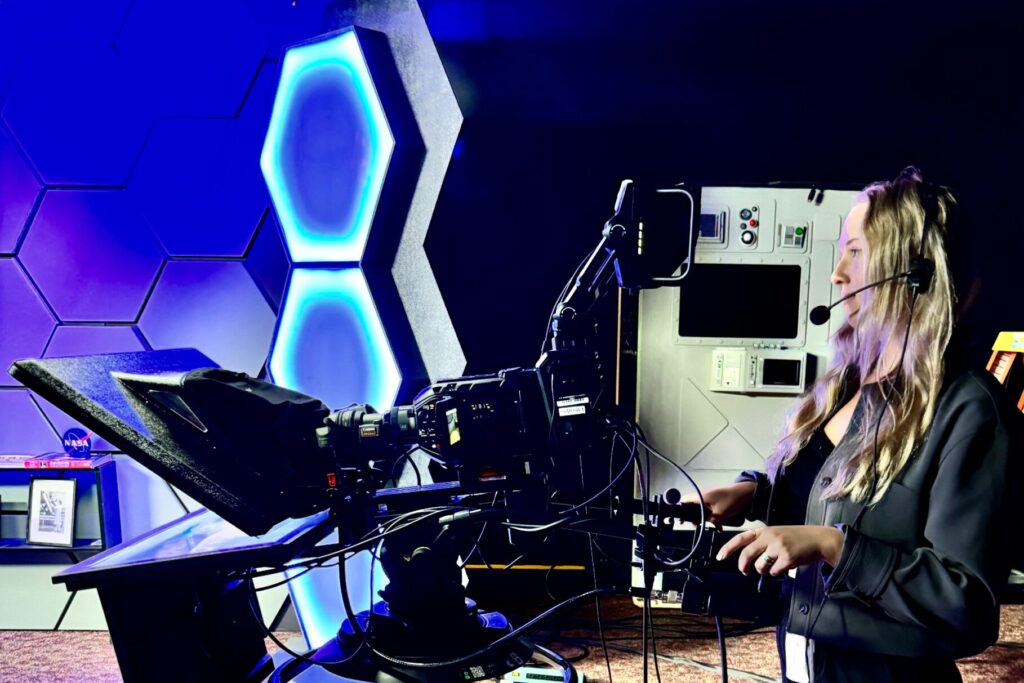
Karly Noetzel ’18 is in her final year of the MFA program in Science and Natural History Filmmaking at Montana State University-Bozeman, and she is also a science video intern at NASA. Her short film, Water Bodies, debuts at the Maui film festival in September. We asked Karly a few questions about her experience at NASA, Neptune’s rings, and the niche skill of translating science and culture to film.
What sparked your interest in this particular branch of filmmaking?
In undergraduate work [at Denison] I was a double major in cinema and global commerce, and I knew I wanted to pursue a master’s. I found that documentary filmmaking is a combination of everything that I’m interested in, from cinema to ecology, astronomy, and natural history.
What is the most interesting thing you have done so far at NASA?
I got to interview a renowned planetary scientist, Heidi Hammel, for videos that I produced about Neptune’s rings and auroras.
That’s amazing. I’m not sure I knew Neptune had rings.
Yes! I worked with the James Webb Space Telescope team; it was the Webb telescope that recently rediscovered these rings. They were last seen in 1989, but these new images really gave everyone a lot more scientific information about it.
Having such a diverse array of subjects and courses at HPA really propelled the trajectory of my education. I got to take astronomy, oceanography, AP environmental science, and film courses.”
How do you describe what you do to other people? How much is art? How much is science?
The filmmaker wears all of the hats. So that comes from conceptualizing to pitching, pre-producing, shooting, editing, animating… all the different things. I gravitate towards ecology, astronomy, and anthropology, and then I work closely with the subjects to come up with the story that I’m trying to convey. Particularly right now, conveying science information for the public is really important.
Absolutely. That’s something you must have the right skill set for and really enjoy.
It’s very fulfilling! It creates a lot of meaning in my life, contributing to the way we are all trying to understand our Earth and humanity and the universe more in a positive way.
Did anyone or anything at HPA inspire your journey?
Having such a diverse array of subjects and courses at HPA really propelled the trajectory of my education. I got to take astronomy, oceanography, AP environmental science, and film courses. All the teachers I had — pretty much in every class at HPA — inspired a lot of opportunities to think about the role of humans on the planet and what issues are present. It’s a big theme in the films I like to make.
What advice do you have for HPA students today?
I think just getting excited about the work you’re doing and what you’re learning is really important. Sharing that with people is contagious and inspires other people to do the same.
What is next for you?
I’ll be graduating with my MFA from Montana in May, and then I also plan to produce my thesis film with NASA about the environmental impact of rocket launches and the research that they’re doing to mitigate the ecological damage. With many things that are going to become a bigger part of our world — whether it’s AI or space travel — looking at it from as many angles as possible is really important to protect the planet.